

Fullscreen Modal
Download
Next
Previous
Download image
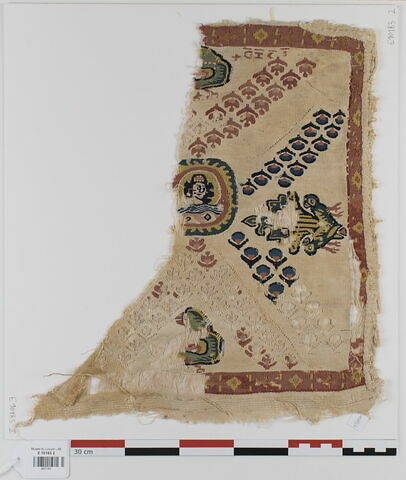
tenture ; châle ; fragment
395 / 641 (époque byzantine)
E 10183 1 ; X 4990 ; TC 785 ; E 80
Département des Arts de Byzance et des chrétientés en Orient
Share this notice

- Inventory number
-
Numéro principal : E 10183 1
Autre numéro d'inventaire : X 4990
Numéro catalogue : TC 785
Numéro catalogue : E 80 - Object name/Title
- Dénomination : tenture (?) ; châle (?) ; fragment
- Description/Features
- Décor : fleur
- Dimensions
- Longueur : 87 cm ; Largeur : 45,5 cm ; Largeur avec accessoire : 90 cm ; Largeur avec accessoire : 47 cm
- Materials and techniques
-
Matériau : laine, lin
Technique : brochage, tapisserie, toile (1 lisière) - Date
- époque byzantine (attribution d'après style) (395 - 641)
- Object history
- Propriétaire précédent : Musée du Louvre, AE, Paris
- Collector / Previous owner / Commissioner / Archaeologist / Dedicatee
-
Tano, Nicolas, Donateur ; Antiquaire / Marchand d'art
- Acquisition details
- don
- Acquisition date
-
date d'arrivée au Musée : 23/06/1887
date de l'inscription sur l'inventaire : 24/08/1889 - Owned by
- Etat
- Held by
- Musée du Louvre, Département des Arts de Byzance et des chrétientés en Orient
- Current location
-
non exposé
-
Bénazeth, Dominique, « Y a-t-il des tissus d’Akhmîm au musée du Louvre ? », dans El-Sayed, Rafed ; Fluck, Cäcilia (dir.), The Textile Centre Akhmîm-Panopolis (Egypt) in Late Antiquity, Material Evidence for Continuity and Change in Society, Religion, Industry and Trade : Proceedings of the international conference organised by Georg-August-Universität Göttingen in cooperation with Skulpturensammlung und Museum für Byzantinische Kunst der Staatlichen Museen zu Berlin – Preußischer Kulturbesitz, Göttingen, 28–30 September 2017, Wiesbaden, Reichert Verlag, 2020, p. 165-180, p. 177
Description
Physical characteristics
Places and dates
History
Location of object
Index
Elément d'un ensemble
Last updated on 07.12.2023
The contents of this entry do not necessarily take account of the latest data.
The contents of this entry do not necessarily take account of the latest data.