

Fenêtre en plein écran
Télécharger
Suivant
Précédent
Télécharger l'image
Stèle de Mesha
-830 / -805 (IXe s. av. J.-C.)
Lieu de découverte : Diban
AO 5066 ; MNB 752 ; MNB 752 BIS ; KAI 181
Département des Antiquités orientales
Partager cette page

Actuellement visible au Louvre
Salle 303
Aile Sully, Niveau 0
- Numéro d’inventaire
-
Numéro principal : AO 5066
Autre numéro d'inventaire : MNB 752
Autre numéro d'inventaire : MNB 752 BIS
Numéro catalogue : KAI 181 - Collection
- Département des Antiquités orientales
- Dénomination / Titre
-
Dénomination : stèle
Titre : Stèle de Mesha - Description / Décor
- stèle (cintré)
Décor : inscription
Etat de l'oeuvre : incomplet ; fragmenté ; recollé ; complété
Précision sur l'objet : Stèle inscrite à sommet cintré. - Inscriptions
- Écriture :
moabite
Inscription :
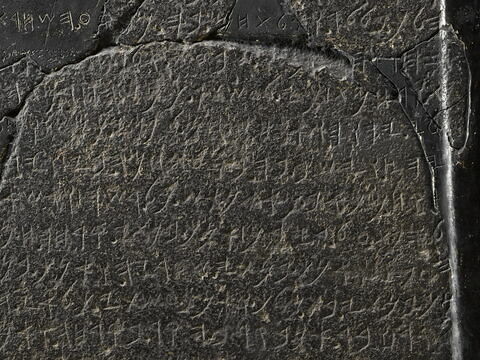
34 lignes en caractère de type phénicien et en dialecte très proche de l'hébreu. Gravé peu après 842 à l'occasion de l'érection d'un sanctuaire au dieu Kamosch. Elle relate la reprise, sur Israël, de nombreux territoires moabites par le roi Mesha
Langue :
moabite
Nature du texte :
texte historique - Dimensions
- Epaisseur : 37 cm ; Hauteur : 125 cm ; Largeur : 69 cm
- Matière et technique
-
Matériau : basalte
Technique : ronde-bosse - Date de création / fabrication
- IXe s. av. J.-C. (Epoque de Mesha vers 830-805) (-830 - -805)
- Lieu de découverte
- Diban
- Détenteur précédent / commanditaire / dédicataire
-
M. Clermont-Ganneau, Charles Simon
- Mode d’acquisition
- achat
- Date d’acquisition
- date : 1873
- Propriétaire
- Etat
- Affectataire
- Musée du Louvre, Département des Antiquités orientales
- Emplacement actuel
-
Sully, [AO] Salle 303 - Levant - Palestine et Transjordanie, des origines à l'âge du fer, Hors vitrine
- Mode d'acquisition
- achat
- Dénomination
- stèle
- Matériaux
- basalte
- Technique
- ronde-bosse
- Description / Décor
- cintré - stèle - inscription
- Langue
- moabite
- Lieux
- Diban
- Nature du texte
- texte historique
- Écriture
- moabite
-
Tafferner, Mario, « “And I Deported ʾAriʾēl, Its Leader, from There”: Line 12 of the Mesha Inscription in Light of Shared Scribal Practices in Moab and Ancient South Arabia », Maarav, 28, 1-2, 2024, p. 56-88
-
Richelle, Matthieu, « A re-examination of the reading BT DWD (“house of David”) on the Mesha Stele », dans Eretz-Israel : archaeological, historical and geographical studies, 34, Ada Yardeni volume. Jerusalem, Israel Exploration Society, in cooperation with the Institute of archaeology, Hebrew University of Jerusalem, 2021, p. 152-159, p. 152-158, ill. p. 154-156
-
Cannavò, Anna ; Schmid, Stephan G., « From Paul Schröder’s archives on Cyprus, IV. The inscriptions from the Lang and Cesnola collections », Cahiers du Centre d'Etudes Chypriotes (CCEC), 50, 2020, 175-193, Disponible sur : https://doi.org/10.4000/cchyp.504 , p. 176, n. 60
-
Finkelstein, Israel ; Na'aman, Nadav ; Römer, Thomas, « Restoring Line 31 in the Mesha Stele: The "House of David" or Biblical Balak? », Tel Aviv. Journal of the Institute of Archaeology of Tel Aviv University, 46-1, 2019, p. 3-11
-
Langlois, Michael, « The Kings, the City and the House of David on the Mesha Stele in Light of New Imaging Techniques », Semitica, 61, 2019, p. 23-47
-
Ercolani, Andrea ; Xella, Paolo (dir.), Encyclopaedic dictionary of Phoenician culture I : Historical characters, Leuven ; Paris ; Bristol, Peeters, 2018, p. 171-173, fig. 46
-
Mesha et la Bible : quand une pierre raconte l'histoire, cat. exp. (Paris, Collège de France, 15 septembre-19 octobre 2018), Paris, Collège de France, 2018
-
Schade, Aaron, « The Mesha Inscription : Clermont-Ganneau's Scribal Exercice on the Reverse of the Stele », Maarav, 20/2, 2013, p. 199-204
-
Routledge, Bruce, « On Water Management in the Mesha Inscription and Moab », Journal of Near Eastern Studies (JNES), 72, 1, 2013, p. 51-64, Disponible sur : https://www.jstor.org/stable/10.1086/669215 , p. 51-64
-
Pritchard, James B., The Ancient Near East : An anthology of texts and pictures, Princeton, Princeton University Press, 2011, XIV, 287-288, ill. 74
-
Bienkowski, Piot ; Millard, Alan, Dictionary of the Ancient Near East, University of Pennsylvania Press, 2010
-
Kaplan, Jonathan, « The Mesha Inscription and Iron Age II Water Systems », Journal of Near Eastern Studies (JNES), 69, 1, 2010, p. 23-29, Disponible sur : https://www.jstor.org/stable/10.1086/654937 , p. 23-29
-
Emerton, John Adney, « Lines 25-6 of the Moabite Stone and a Recently-Discovered Inscription », Vetus Testamentum, 55, 3, 2005, p. 293-303, Disponible sur : https://www.jstor.org/stable/20503920 , p. 293-303
-
Emerton, John Adney, « The Value of the Moabite Stone as an Historical Source », Vetus Testamentum, 52, 4, 2002, p. 483-492, Disponible sur : https://www.jstor.org/stable/1585139 , p. 483-492
-
Lemaire, André ; Boyer, Frédéric, Le monde de la Bible, Paris, Bayard Presse, 1999, p. 82
-
Delpont, Eric (dir.), Jordanie, sur les pas des archéologues, cat. exp. (Paris, Institut du Monde arabe, 13 juin - 5 octobre 1997), Paris, Institut du Monde arabe, 1997, p. 27
-
Na'aman, Nadav, « King Mesha and the Foundation of the Moabite Monarchy », Israel Exploration Journal, 47, 1/2, 1997, p. 83-92, Disponible sur : https://www.jstor.org/stable/27926460 , p. 83-92
-
Rionnet, Florence, L’Atelier de moulage du musée du Louvre (1794-1928), Paris, Réunion des musées nationaux, (Notes et documents des Musées de France, 28), 1996, p. 128, n° 58
-
Niccacci, Alviero, « The Stele of Mesha and the Bible: Verbal System and Narrativity », Orientalia, Nova Series (Or NS), 63, 3, 1994, p. 226-248, Disponible sur : https://www.jstor.org/stable/1585139 , p. 226-248
-
Dearman, John Andrew, Studies in the Mesha inscription and Moab, Atlanta, Scholars Press, (Archaeology and Biblical Studies, 2), 1989
-
Amiet, Pierre (dir.), La Voie Royale : 9000 ans d'art au royaume de Jordanie, cat. exp. (Paris, Musée du Luxembourg, 1987), Paris, Association française d'action artistique, 1987, n° 156
-
Der Königsweg : 9000 Jahre Kunst und Kultur in Jordanien und Palästina, cat. exp. (Catalog of exhibition held 3 Oct. 1987 to 27 Mar. 1988 at the Rautenstrauch-Joest-Museum für Völkerkunde, Köln; Jan. to Nov. 1988 at the Schallaburg; and Jan. to Mar. 1989 at the Prähistorische Staatssammlung, München), Mainz am Rhein, Philip von Zabern, 1987, p. 121-123
-
Horn, Siegfried H, « Why the Moabite Stone Was Blown to Pieces », Biblical Archaeology Review, 12, 3, 1986, p. 50-61, Disponible sur : https://library.biblicalarchaeology.org/article/why-the-moabite-stone-was-blown-to-pieces/ , p. 50-61
-
Beeston, A. F. L., « Mesha and Ataroth », The Journal of the Royal Asiatic Society of Great Britain and Ireland, 2, 1986, p. 143-148, Disponible sur : https://www.jstor.org/stable/25211841 , p. 143-148
-
Müller, Walter W., « Moabitische Historische Inschriften », dans Kaiser, Otto (dir.), Texte aus der Umwelt des Alten Testaments Band I, Lieferung 6 Historisch-chronologische Texte III, Gütersloh, Gütersloher Verlagshaus Gerd Mohn, 1985, p. 646-650, p. 646-650
-
Horn, Siegfried H, « The Discovery of the Moabite Stone », dans Meyers, Carol L. ; O'Connor, M. (dir.), The Word of the Lord shall go forth : essays in honor of David Noel Freedman in celebration of his sixtieth birthday, Winona Lake, Eisenbrauns, 1983, p. 497-505, p. 497-505
-
André-Leicknam, Béatrice ; Ziegler, Christiane (dir.), Naissance de l'écriture : cunéiformes et hiéroglyphes, cat. exp. (Paris, Galeries nationales du Grand Palais, 7 mai-9 août 1982), Paris, Réunion des musées nationaux (RMN), 1982, p. 181, n° 122
-
Gibson, John C. L., Textbook of Syrian Semitic Inscriptions (TSSI), vol. III, Phoenician Inscriptions including inscriptions in the mixed dialect of Arslan Tash, Oxford, Clarendon Press, 1982, p. 71-83
-
Auffret, Pierre, « Essai sur la structure littéraire de la stèle de Mésha », Ugarit-Forschungen (UF), 12, 1980, p. 109-124
-
Briend, Jacques ; Seux, Marie-Joseph, Textes du Proche-Orient ancien et histoire d'Israël, Paris, Éditions du Cerf, (Etudes annexes de la Bible de Jérusalem), 1977, p. 90-92
-
Zur Geschichte des Alphabets, cat. exp. (Bâle, Museum für Papier, Schrift und Druck, avril-oct. 1976), Bâle, 1976, p. 9
-
Lipinski, Edward, « Etymological and Exegetical Notes on the Mesha' Inscription », Orientalia, NS 40, 1971, p. 325-340, p. 325-340
-
Miller, Patrick D. Jr, « A Note on the Meša‘ Inscription », Orientalia, 38, 3, 1969, p. 461-464, Disponible sur : http://www.jstor.org/stable/43074301 , p. 461-464
-
Donner, Herbert ; Röllig, Wolfgang, Kanaanische und aramäische Inschriften (KAI), Wiesbaden, O. Harrassowitz, 1966, n° 181
-
Michaud, Henri, « Sur un fragment de la stele de Meša », Vetus Testamentum, 8/3, 1958, p. 302-304, Disponible sur : http://www.jstor.org/stable/1515964, p. 302-304
-
Pritchard, James B., Ancient Near Eastern Texts Relating to the Old Testament (ANET), Princeton, NJ, Princeton University Press, 1955, p. 320-321
-
Dussaud, René, « Nouvelles archéologiques. Une correction à la ligne 12 de la stèle de Mésa », Syria. Revue d'art oriental et d'archéologie, 28, 3-4, 1951, p. 347-361, Disponible sur : https://www.persee.fr/doc/syria_0039-7946_1951_num_28_3_8428 , p. 48
-
Bossert, Helmuth Theodor, Altsyrien. Kunst und Handwerk in Cypern,Syrien, Palästina, Transjordanien und Arabien von den Anfängen bis zum völligen Aufgehen in der griechisch-römischen Kultur. Unter Mitarbeit von Rudolf Naumann, Tübingen, Ernst Wasmuth, 1951, n° 881
-
Albright, William Foxwell, « Is the Mesha Inscription a Forgery? », The Jewish Quarterly Review, 35, 3, 1945, p. 247-250, Disponible sur : https://www.jstor.org/stable/1452186 , p. 247-250
-
Albright, William Foxwell, « Is the Mesha Inscription a Forgery? », The Jewish Quarterly Review, 35, 3, 1945, p. 247-250, Disponible sur : https://www.jstor.org/stable/1452186 , p. 139-164
-
Contenau, Georges, Manuel d'archéologie orientale depuis les origines jusqu'à l'époque d'Alexandre : histoire de l'art (fin) Ier millénaire jusqu'à Alexandre, 3, Paris, Picard, 1931, p. 1390, fig. 856
-
Contenau, Georges, Les antiquités orientales : monuments hittites, assyriens, phéniciens, perses, judaïques, chypriotes, araméens, Paris, Musée du Louvre / éd. Albert Morancé, (Documents d’art), 1927, p. 18, pl. 28
-
Contenau, Georges, La civilisation phénicienne, Paris, Payot, 1926, p. 250
-
Dussaud, René, Les monuments palestiniens et judaïques : Moab, Judée, Philistie, Samarie, Galilée, [Musée du Louvre/Département des Antiquités orientales], Paris, Ernest Leroux, 1912, Disponible sur : http://bibliotheque-numerique.inha.fr/idurl/1/7289 , p. 4-19, n° 2
-
Jeremias, Alfred, Das Alte Testament im Lichte des Alten Orients : Handbuch zur biblisch-orientalischen Altertumskunde, Leipzig, J. C. Hinrichs, 1904, p. 261-266
-
Löwy, Albert, Die Echtheit der Moabitischen Inschrift im Louvre, Vienne, A. Holzhausen, 1903
-
Davis, John D., « The Moabite Stone and the Hebrew Records », Hebraica, 7, 3, 1891, p. 178-182, Disponible sur : https://www.jstor.org/stable/527310 , p. 178-182
-
Héron de Villefosse, Antoine, Notice des monuments provenant de la Palestine et conservés au Musée du Louvre (Salle judaïque), Paris, Ch. de Mourgues frères, 1879, Disponible sur : http://bibliotheque-numerique.inha.fr/idurl/1/8796 , p. 1-15, n° 1
-
Clermont-Ganneau, Charles, La stèle de Dhiban, ou stèle de Mesa, roi de Moab, 896 avant J. C. : lettres à M. le Cte de Vogüé, Paris, J. Baudry ; Didier et Cie, 1870, Disponible sur : http://gallica.bnf.fr/ark:/12148/bpt6k5038493
-
- Qumrân. Le secret des manuscrits de la Mer morte, Paris (France), Bibliothèque nationale de France, site François Mitterrand, 12/04/2010 - 11/07/2010
description
Caractéristiques matérielles
Lieux et dates
Données historiques
Localisation de l'œuvre
Index
Bibliographie de comparaison
- Dobbs-Allsopp, F. W. ; Pioske, Daniel, « On the Appearance of Royal Inscriptions in Alphabetic Scripts in the Levant : an Exercice in "Historically Anchored Philology" », Maarav, 23/2, 2019, p. 389-442, p. 416-417
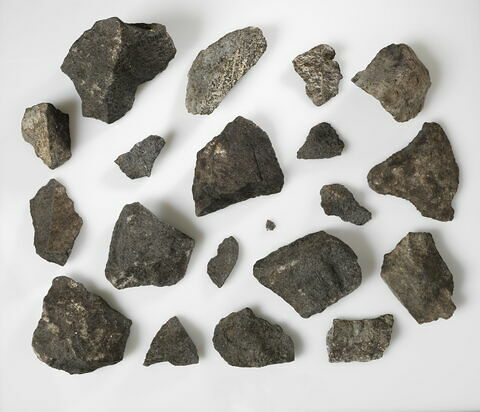
Fragment
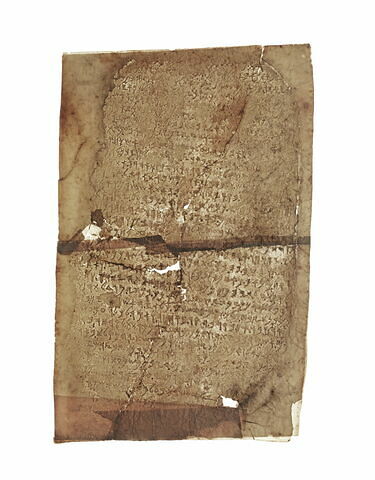
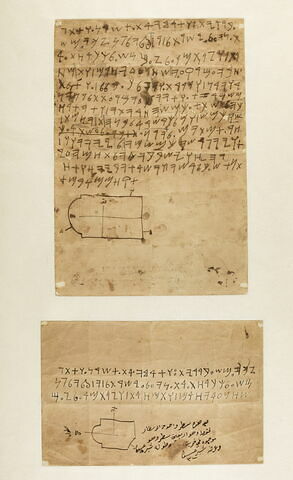
Copie
Dernière mise à jour le 02.06.2026
Le contenu de cette notice ne reflète pas nécessairement le dernier état des connaissances
Le contenu de cette notice ne reflète pas nécessairement le dernier état des connaissances